What total budget are you planning for the floor?
HomeAdvisor's typical polished concrete project is $4,500 within a $1,000–$8,000 range.
No votes yet. Yours will be the first. · saved on this device
Loading...
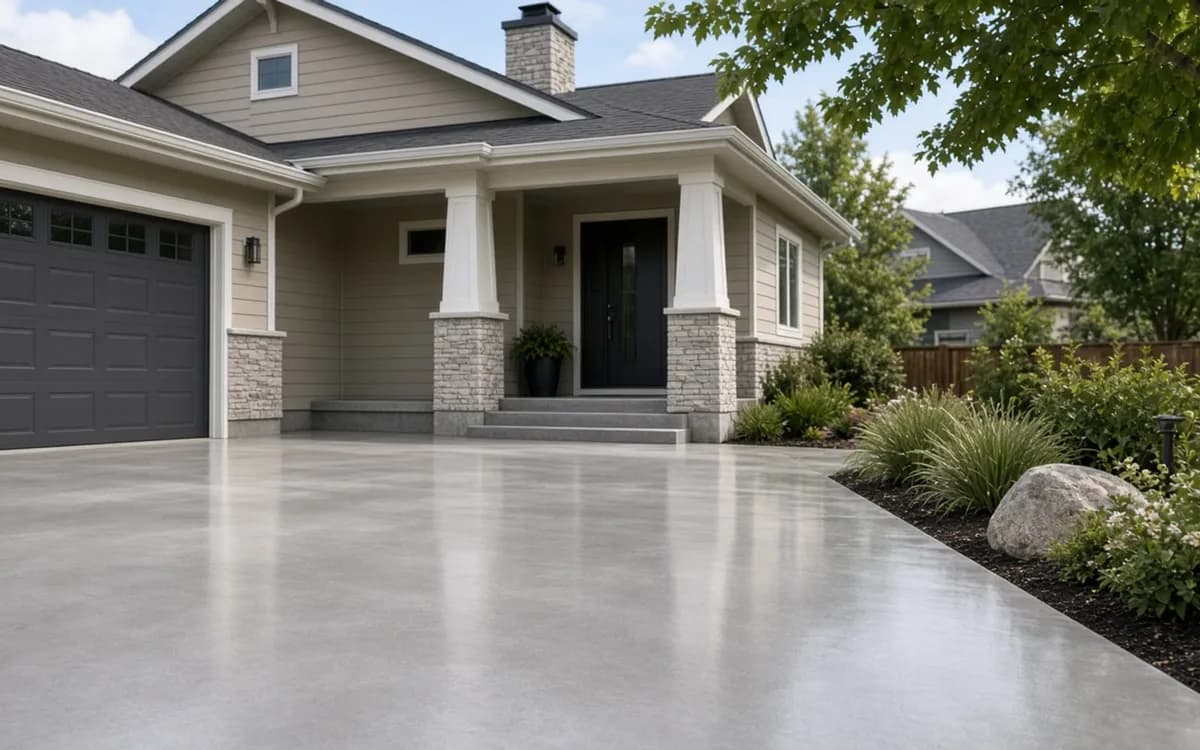
Concrete Finish Notes · Concrete Polishing cost guide
Polishing an existing concrete floor costs $3 to $12 per square foot in Angi's 2026 guide, and HomeGuide's figures run from about $3 for a matte cream finish to $15 for high gloss with full aggregate. Floors under 1,000 square feet sit at the top of the range. Labor is most of the price, so sheen and passes drive the total.
The price of a polished floor is mostly the price of time on a grinder. Every level of sheen, every millimeter of deeper cut for aggregate exposure, and every extra hour spent on edges or coating removal shows up in the quote. Materials, including diamonds and densifier, are a smaller slice. This page breaks down where the money goes so you can predict your own number and decide which choices are worth paying for.
The price table and calculator on this page apply published ranges to your floor. The sections below explain the reasoning behind those ranges, how size and access change them, what add-ons cost, and how to trim a budget without undermining the result. Read them in order: the range first, then the factors that move your floor within it, then the sample budgets. That sequence makes it easier to see which of your choices is costing the most.
| Item | Low | High | Unit | Notes |
|---|---|---|---|---|
| Matte or honed polish (CPC Level 1–2) | $3 | $6 | per sq ft | HomeGuide 2026 |
| Medium gloss polish (Level 3) | $5 | $10 | per sq ft | HomeGuide 2026 |
| High gloss polish (Level 4) | $6 | $15 | per sq ft | HomeGuide 2026; Angi $8–$15 |
| Full aggregate exposure (Class C) | $6 | $12 | per sq ft | HomeGuide; deeper cut, more passes |
| Additional grinding pass | $3 | $5 | per sq ft | HomeAdvisor |
| Stain-guard treatment | $1 | $3 | per sq ft | HomeGuide; reapply every 2–5 years |
| Basement access premium | $10 | $30 | percent | HomeGuide |
Three publishers set the frame. Angi gives $3–$12 per sq ft, and prices a new slab for polishing at $4–$8/square foot. HomeGuide gives $3–$12 per sq ft for basic work, with decorative options higher. Homewyse estimates $8.26–$9.77 per sq ft for a defined mid-level scope with three grinding passes, densifier and two polishing passes. The overlap between them is the honest planning range for a typical house. Where a proposal falls outside that overlap, the explanation should be visible in the scope: coating removal, heavy repairs, a basement, or a higher sheen than the publishers assumed.
Tier is set by two choices. Sheen: HomeGuide's range climbs $3–$6 up to $6–$15 from matte to high gloss, and Angi's July 2026 guide puts matte at $2–$6/square foot, semigloss at $3–$8/square foot and high gloss at $8–$15/square foot. Exposure: cream, salt-and-pepper and full aggregate price at $3–$8 / $4–$10 / $6–$12 respectively. A satin cream finish sits at the bottom; a high-gloss, full-aggregate floor sits at the top. The two choices stack, because deeper exposure and higher gloss both add passes. Deciding them before bids arrive keeps proposals comparable and avoids paying for a look you did not ask for.
Installer-published figures run higher at the deep end. Stelr, a contractor marketplace, prices grind and seal at $2–$5 per sq ft and splits exposure into five tiers. The table in this section sets its 2026 tiers beside HomeGuide's; where the two differ, Stelr's higher full-aggregate range is closer to what a specialist bidding a rock-cut floor tends to quote.
| Tier | HomeGuide 2026 | Stelr 2026 (contractor source) |
|---|---|---|
| Grind and seal (no polish) | Not priced as a polish tier | $2–$5 per sq ft |
| Cream (Class A) | $3–$8 per sq ft | $3–$8 per sq ft |
| Salt-and-pepper (Class B) | $4–$10 per sq ft | $5–$10 per sq ft |
| Medium aggregate | Not listed separately | $7–$12 per sq ft |
| Full aggregate (Class C) | $6–$12 per sq ft | $10–$15+ per sq ft |
Size has a bigger effect on per-foot cost than most owners expect. HomeGuide reports $8–$15+ vs $3–$6 for floors under 1,000 square feet against floors over 5,000. The reason is fixed cost: equipment transport, setup, dust extraction and a full set of tooling are needed regardless of size, and small rooms have more edge work per square foot.
HomeAdvisor's typical residential spend of $4,500 reflects that most house projects are small by commercial standards. HomeGuide says hard-to-reach basements can add +10% to 30%, and fixed setup costs like that are why grouping helps. To improve the per-foot price, combine areas into one visit: a basement and garage, or a main floor and hallway. Contractors can then spread the fixed costs over more square footage. Ask each bidder whether their price changes if you add a second area to the same visit; the answer shows how much of the quote is fixed setup.
The size table in this section combines HomeGuide's two anchors with Stelr's 2026 size bands. Both publishers show the per-foot price roughly halving between a single room and a floor of several thousand square feet.
| Floor size | Per sq ft | Source |
|---|---|---|
| Under 500 sq ft | $8–$15 | Stelr 2026 |
| Under 1,000 sq ft | $8–$15+ | HomeGuide 2026 |
| 500–1,000 sq ft | $6–$12 | Stelr 2026 |
| 1,000–3,000 sq ft | $5–$10 | Stelr 2026 |
| 3,000–10,000 sq ft | $4–$8 | Stelr 2026 |
| Over 5,000 sq ft | $3–$6 | HomeGuide 2026 |
| 10,000+ sq ft | $3–$6 | Stelr 2026 |
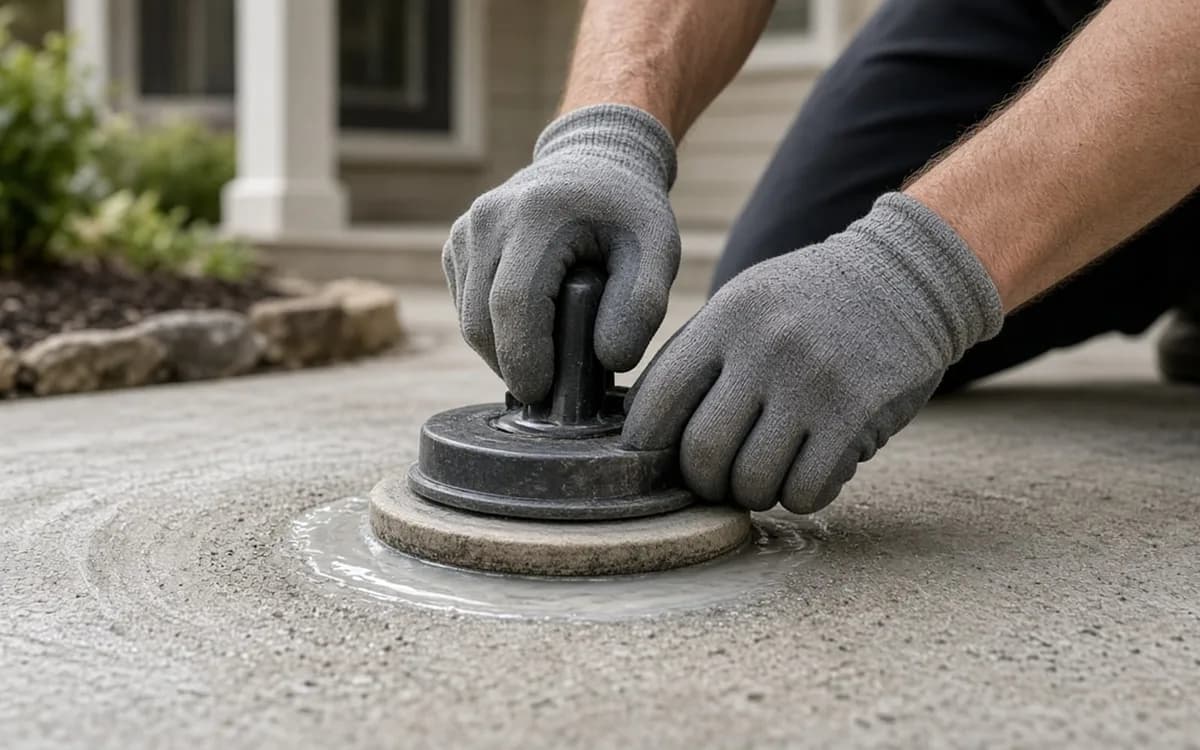
HomeGuide puts polishing labor at $40–$100 per hour and says it is most of the project cost. Each pass across the floor is operator time, and HomeAdvisor prices additional passes at $3–$5 per sq ft. Edges, stairs, columns and built-ins are ground by hand and take far longer per square foot than open floor. That is why two bids with similar material lists can still be far apart: the difference is the time each contractor expects the floor to take.
Access adds labor. HomeGuide notes a +10% to 30% premium for hard-to-reach basements, where heavy grinders must be carried down stairs and maneuvered around posts and mechanicals. Upper floors, narrow doorways and occupied homes where work must be phased also add time. Mention all of these in your request so bids reflect them.
HomeGuide puts most residential polishing at 2–4 days for floors up to about 2,000 square feet. Each extra day of work is mostly labor cost, so anything that adds days adds money: coating removal, heavy crack repair, leveling, dye with drying time, or a mock-up visit on a separate day. Ask each bidder how many days they expect on site; a schedule that seems too short for the scope is worth questioning before work begins.
Booking ahead helps: HomeGuide puts polishing labor at $40–$100 per hour, most of the project cost, and busy specialists fill their calendars early. Rushing also costs. Asking for work over a weekend or compressed into a single day can mean a larger crew or overtime rates. Delays you cause, such as rooms not cleared on schedule, may trigger rescheduling fees. A realistic schedule agreed in writing, with the mock-up done well ahead, keeps the price closest to the original bid.
A stain guard is usually worth it in kitchens, dining areas and garages; HomeGuide prices it at $1–$3 every 2–5 yrs. Dye is worth it when the slab's natural color is uneven or you want a specific tone, at the rates on the staining cost page. Crack and joint filling is almost always worth it in living areas, because open cracks collect dirt and chip at the edges.
Add-ons that are more discretionary include full aggregate exposure, the highest gloss level, decorative scoring and custom logos. HomeGuide lists logos from $300 to over $2,000. These change the look significantly but not the durability. Decide on them after seeing a mock-up at the base specification. A mock-up at the base specification, seen in your own light, often shows that the simpler finish already looks the way you hoped.
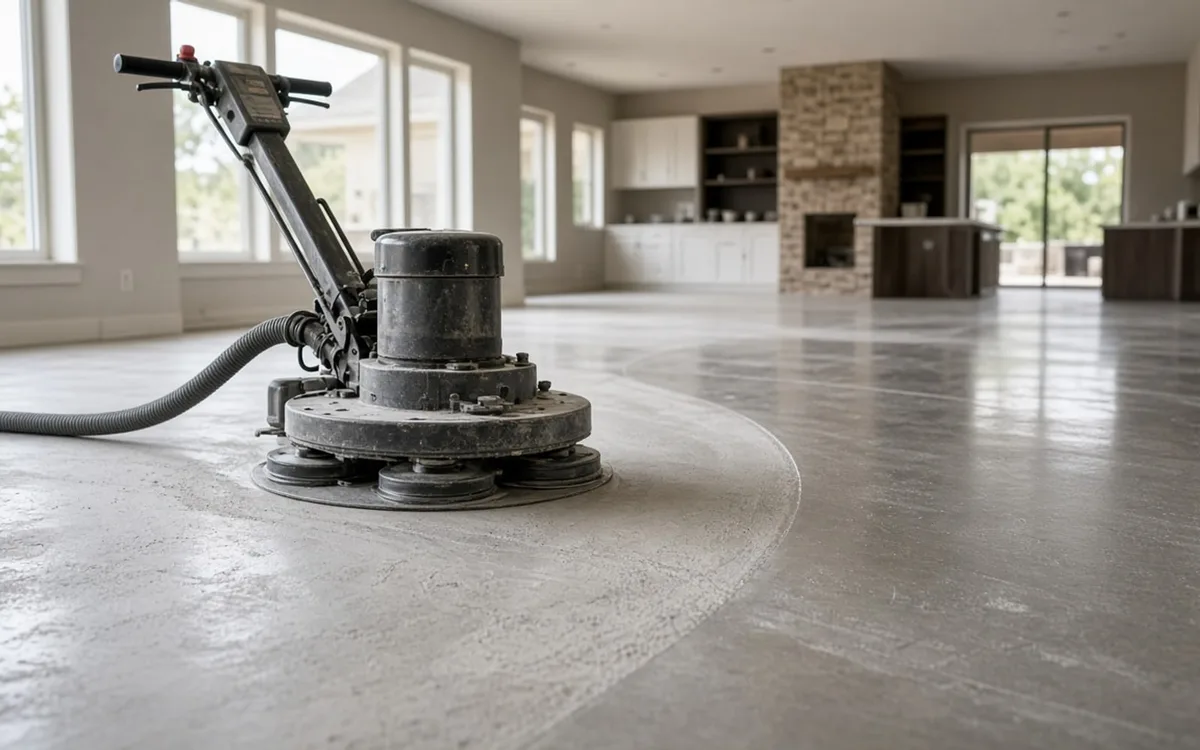
Repairs are the most common reason a final invoice exceeds the first estimate. Cracks are usually filled per linear foot, patches per area and joints per run, and none of these is fully visible until the old covering is off. Coating removal is priced per pass, and HomeAdvisor's $3–$5 per sq ft per pass shows how quickly thick epoxy or mastic adds up across a whole floor. Stelr's 2026 guide puts removal of epoxy, paint or thinset at $2 to $4 per square foot on top of the polish, and major crack or joint stabilization at $3 to $5. A test patch before the bid narrows the uncertainty considerably.
Ask each contractor to price these items as unit rates rather than a single allowance. Then, if grinding exposes more cracking than expected, the extra cost follows an agreed formula instead of a number set on the day. Unit rates also let you compare bids that assumed different amounts of repair. The grinding and leveling cost page covers removal and leveling prices in more depth.
HomeGuide prices cream, salt-and-pepper and full aggregate at $3–$8 / $4–$10 / $6–$12 per square foot; on a polished floor, choose where to save. Drop one sheen level. Moving from high gloss to medium or satin removes one or more passes and is the largest single saving. Next, choose cream or salt-and-pepper over full aggregate. Third, reduce the area: polish the main living space and grind and seal utility areas. The grind-and-seal comparison explains that trade.
Do not cut the mock-up, densifier, crack treatment or dust control. Those protect the result and your household. And do not assume a lower bid is equivalent without checking passes and grits; the savings may come from skipped steps that show up as haze or scratches once the floor is finished.
These examples apply the publishers' ranges to common sizes. They assume a sound slab with ordinary repairs and no coating removal. Use the calculator for your own dimensions and the estimate request for written local prices. Coating removal, basement access and heavy crack repair would push any of them higher, while combining areas into one visit can pull the per-foot price toward the middle of the range.
| Example | Specification | Planning range |
|---|---|---|
| 300 sq ft home office | Satin, cream, small-floor pricing | $2,400–$4,500 |
| 800 sq ft basement | Satin, small-floor pricing plus 10–30% access | $7,000–$15,600 |
| 1,200 sq ft main floor | Medium gloss, guard in kitchen | $6,000–$12,000 plus guard |
| 2,000 sq ft open plan | High gloss, full aggregate | $12,000–$30,000 |
By the numbers
Planning figures from published U.S. sources; every card links to where the number came from.
$2–$5 per sq ft
Grind and seal costs $2 to $5 per sq ft, against $3–$8 for a cream polish and $10–$15+ for full aggregate
Stelr's 2026 guide, published by a contractor marketplace, prices grind and seal $2–$5, cream polish $3–$8, salt-and-pepper $5–$10, medium aggregate $7–$12 and full aggregate $10–$15+ per sq ft. It also puts floors under 500 sq ft at $8–$15 and 10,000+ sq ft at $3–$6.
Stelr polished concrete cost guide (contractor source) (2026)+$2–$3 per sq ft
Polishing on raised decks or subfloors adds $2 to $3 per sq ft for waterproofing and underlayment
Concrete Network's polished concrete cost page (reviewed January 10, 2023) also adds about $2 per sq ft for extensive crack and repair prep, and says basic polished concrete can cost half as much as hardwood, or less.
Concrete Network polished concrete floor cost (2023)$3–$12 per sq ft
Angi prices polishing an existing concrete floor at $3 to $12 per square foot
Angi's polishing cost guide describes polishing existing floors; removal of coverings, repairs, design effects and new slab construction are separate scope items. It is the benchmark behind this site's calculator.
Angi cost to polish concrete floors (2026)$3–$6 up to $6–$15
Matte polish $3–$6, low sheen $4–$8, medium gloss $5–$10, high gloss $6–$15 per sq ft
Each step up in gloss adds grinding and polishing steps; HomeGuide's high-gloss range is roughly double matte. Decide on sheen before collecting bids so quotes are comparable.
HomeGuide polished concrete floor cost guide (2026)The calculator uses the same concrete polishing benchmarks as this guide. Set the size and tier, then request a written estimate to check it against a real proposal.
Homeowner polls
HomeAdvisor's typical polished concrete project is $4,500 within a $1,000–$8,000 range.
No votes yet. Yours will be the first. · saved on this device
CPC defines the levels by Distinctness of Image; HomeGuide prices matte at $3–$6 and high gloss at $6–$15 per sq ft.
No votes yet. Yours will be the first. · saved on this device
Deeper exposure means more passes; HomeGuide prices cream at $3–$8 and full aggregate at $6–$12 per sq ft.
No votes yet. Yours will be the first. · saved on this device
Exposing more stone means grinding deeper into the slab, which takes more coarse passes and wears tooling faster. HomeGuide's full-aggregate range starts at about double the cream finish for that reason. Deeper grinding can also reveal voids and uneven stone that need filling, adding labor.
Often slightly lower per foot for a clean garage because it is open, empty and easy to access. It rises if oil staining needs treatment, the slab has a steep slope toward the door, or salt damage needs repair. Guards are more important in garages and add to the total.
Carpet removal is quick; the tack strips and staples take more time. Tile and thinset or mastic can add a full day or more of coarse grinding. Ask whether removal is included, priced separately, or expected to be done before the contractor arrives.
Some contractors include it; others charge a modest fee and credit it against the full contract. It usually takes a few hours of grinding plus densifier and a polish on a small area. The price is small compared to the cost of a floor you dislike, so it is rarely worth skipping.
Less than labor. Densifier covers a large area per gallon, and PROSOCO lists 500 to 1,000 square feet for its lithium product. Diamonds wear with each pass and are priced into the per-pass cost. Dyes and guards add more, but labor remains the largest share.
Labor rates generally run higher in expensive metros, and HomeGuide notes urban and specialist contractors sit at the top of its labor range. On the other hand, more contractors compete in cities with commercial polishing work. Rural areas may have fewer options and add travel costs.
Clearing the room, removing baseboards and pulling carpet are reasonable owner tasks. Grinding and polishing with rented equipment is possible but hard to do evenly, and poor early passes cannot be fixed by later ones. Most owners save more by choosing a lower sheen than by attempting the grinding.
 Concrete Staining & Dyeing · Cost guideWhat it costs to stain or dye a concrete floor in 2026
Staining an existing concrete floor runs $3 to $15 per square foot in HomeGuide's 2026 guide, with acid stain up to $25 for high-end designs.
 Concrete Grinding & Leveling · Cost guideConcrete grinding and leveling costs: passes, overlays and lifting
Each grinding pass costs $3 to $5 per square foot in HomeAdvisor's 2026 guide, and HomeGuide puts concrete leveling at $3 to $12 per square foot or $700 to $5,000 per project.
 Concrete Sealing & Protection · Cost guideWhat sealing and protecting a concrete floor costs in 2026
Cleaning and sealing concrete costs $1 to $3 per square foot in HomeGuide's guide, with urethane, epoxy and polyaspartic sealers up to three times that.
 Service guideConcrete Polishing
Concrete polishing grinds an existing slab with progressively finer diamond abrasives, hardens it with a densifier and refines it to a specified sheen and aggregate exposure.
Service guideConcrete Grinding & LevelingGrinding uses coarse diamond tooling to remove coatings, adhesives, lips and high spots and to open a surface profile for whatever finish follows.
Service guideConcrete Staining & DyeingStaining and dyeing add color to a concrete slab by penetrating the surface rather than covering it, so the aggregate, patches and variation remain part of the look.
 Free toolPolished concrete cost calculator: a planning range for your square footage
Size, material tier and complexity in, a realistic budget range out.
 Free toolConcrete floor options compared on the numbers
Side-by-side tables for the decisions that change the price most.
 Free toolConcrete finish quiz: can you read a polishing proposal?
9 questions that show what you already know and what to check next.
 Free toolPolls: what other homeowners planning concrete floors decided
See what other planners chose and add your vote.
Tell us the size, the condition of what is there now, and what you want to change. Concrete Finish Notes passes your request to independent local professionals, who reply with written, no-obligation estimates. The service is free to use.