Which service are you mainly here for?
No votes yet. Yours will be the first. · saved on this device
Loading...
Concrete Finish Notes · Free tools
Four tools turn the statistics on this site into decisions: a cost calculator anchored to Angi's and HomeGuide's 2026 ranges, comparison pages that set polished against epoxy and stain against dye on the numbers, a quiz that narrows sheen level and exposure class, and polls that show what other planners chose. Use them before requesting estimates so the proposals answer the right question.
 Free toolPolished concrete cost calculator: a planning range for your square footage
Size, material tier and complexity in, a realistic budget range out.
 Free toolConcrete floor options compared on the numbers
Side-by-side tables for the decisions that change the price most.
 Free toolConcrete finish quiz: can you read a polishing proposal?
9 questions that show what you already know and what to check next.
 Free toolPolls: what other homeowners planning concrete floors decided
See what other planners chose and add your vote.
By the numbers
$3–$12 per sq ft
Angi prices polishing an existing concrete floor at $3 to $12 per square foot
Angi's polishing cost guide describes polishing existing floors; removal of coverings, repairs, design effects and new slab construction are separate scope items. It is the benchmark behind this site's calculator.
Angi cost to polish concrete floors (2026)$3–$6 up to $6–$15
Matte polish $3–$6, low sheen $4–$8, medium gloss $5–$10, high gloss $6–$15 per sq ft
Each step up in gloss adds grinding and polishing steps; HomeGuide's high-gloss range is roughly double matte. Decide on sheen before collecting bids so quotes are comparable.
HomeGuide polished concrete floor cost guide (2026)$0.18–$0.40 per sq ft/yr
Commercial polished concrete maintenance costs $0.18 to $0.40 per sq ft per year vs $0.65–$1.10 for a full VCT program
Millfac's March 2026 facility data includes auto-scrubbing, periodic diamond-pad repolishing and densifier reapplication for polished concrete; VCT strip-and-wax alone is $0.35 to $0.65 per event.
Millfac commercial floor maintenance cost data (2026)31.89%
Residential projects are about 32% of polished concrete demand; non-residential 68%
Mordor Intelligence's 2025 end-user split, with non-residential growing faster at 6.88% CAGR through 2031. Polished concrete remains primarily a commercial finish, but homes are a substantial minority.
Mordor Intelligence polished concrete market report (2026)The hardest part of a concrete floor project is deciding what to ask for. Sheen level, exposure class, color, protection and the order of operations all affect the price, and Angi's $3–$12 per sq ft range is wide enough that a proposal cannot be judged without knowing which of those choices it includes. These tools exist to make those choices before the proposals arrive.
Each tool uses the same sourced figures as the rest of the site, and each links back to the service page that explains the trade-off in depth. None of them replaces a mock-up on your slab or a pro's assessment; they are for arriving at that assessment with a specification in hand and a planning number in mind.
The calculator takes square footage, a sheen tier, a slab-condition tier and add-ons such as dye, stain guard, crack repair and coating removal, and returns a planning range built on HomeGuide's $3–$6 up to $6–$15 and Angi's figures, whose flooring guide spans $2–$16 per sq ft across design and sheen tiers. It applies a small-area premium because HomeGuide's data shows floors under 1,000 square feet costing far more per square foot than large ones, and it estimates days from HomeGuide's timeline guidance.
It does not know your slab. It cannot see the oil in the garage corner, the thin basement slab or the carpet adhesive that takes three passes to remove. Treat its output as the range within which sensible proposals should land, and treat a proposal far outside it as a question to ask rather than a bid to accept or reject.
When two options compete for the same floor. The comparisons set polished concrete against epoxy for a garage, acid stain against dye for a living room, honed against high gloss for a kitchen, grind-and-seal against a full polish for a basement, and mudjacking against foam for a settled slab. Each has cost, lifespan, maintenance, appearance, climate fit, install time and resale rows, with a verdict on when each option wins and questions specific to the pair.
The comparisons use the site's stats directly: Millfac's $0.18–$0.40 per sq ft/yr for polished concrete upkeep, HomeGuide's $1–$3 per sq ft for cleaning and sealing, the CPC charts for appearance. They are honest about where an option loses, and they link to the service page for the option that wins in your case.
The quiz is a knowledge check rather than a recommendation engine: nine questions on levels, classes, costs, densifiers, slip resistance and process, each with an explanation grounded in a sourced figure. Taking it before reading the service pages shows where your assumptions are wrong; taking it after confirms you can read a proposal. Most homeowners are surprised by the densifier question and the small-job premium.
The polls are the opposite: no right answers, just what other planners on this site chose for sheen, exposure, space, worry and protection. They are anonymous and cumulative, and they are useful mostly for calibration. If most planners considering a garage chose Level 2 with a guard, that is a reasonable place to start your own thinking, and garages are common: our analysis of the federal government's 2024 household survey found 42.9% of homes have an attached garage.
Quiz first, to learn the vocabulary. Calculator second, for a range. Comparisons third, if you are torn. Polls fourth, for calibration. Then the service page for the finish you have chosen, the contact page for what to include in a request, and the reviews guide while you wait for proposals. The sequence takes an hour and changes the quality of every proposal you receive.
Residential work is 31.89% of the polishing market per Mordor Intelligence, and pros who take residential jobs between commercial ones appreciate a homeowner who arrives with a level, a class and a square footage. The tools are how you become that homeowner. HomeGuide prices jobs under 1,000 sq ft against those over 5,000 at $8–$15+ vs $3–$6 per square foot, so small residential floors carry mobilization costs and gain most from a tight specification; an hour with the tools makes that easier.
Homeowner polls
No votes yet. Yours will be the first. · saved on this device
HomeAdvisor's typical polished concrete project is $4,500 within a $1,000–$8,000 range.
No votes yet. Yours will be the first. · saved on this device
Yes and no: they are free and need no account. The calculator, comparisons and quiz run in the browser; the polls record an anonymous vote so the tallies accumulate. Nothing you enter is tied to an estimate request unless you choose to send one from the contact page.
It uses HomeGuide's and Angi's 2026 figures with a small-area premium and add-ons, and sensible proposals for a typical slab land inside it. Removal of unknown coverings, thin or soft slabs and heavy repairs push real bids above it. Use it to spot proposals that need explaining, not to negotiate.
They can tell you which option wins on each factor and under which conditions, using sourced numbers. They cannot see your slab, your room's light or your tolerance for variation. Read the verdict, then take the answer to a mock-up. The comparison narrows the choice; the sample on your floor makes it.
It is scored so you can see which explanations to read. A low score before reading the site is normal; the trade's vocabulary is not common knowledge. A low score after reading the service pages suggests going back to the polishing page's specification section, which is where most of the answers live.
Visitors to this site who are planning or have completed a concrete floor project. The tallies are self-selected and small compared with a national survey, so treat them as calibration among people with the same question, not as market data. The sourced stats on each page are the market data.
The comparisons and quiz apply; the calculator is tuned to residential areas up to 5,000 square feet and residential per-square-foot rates. Commercial floors over 5,000 square feet drop toward HomeGuide's $3 to $6 range and involve specifications, F-numbers and joint details this site does not cover. Ask a commercial polishing contractor directly.
Ask the pro why. The tools are built on published national ranges and standards; the pro has seen your slab. A pro who says the calculator's range is low because the carpet adhesive needs three passes is probably right. A pro who says CPC levels do not apply to residential work is not, and that is a different kind of answer.
 Service guideConcrete Polishing
Concrete polishing grinds an existing slab with progressively finer diamond abrasives, hardens it with a densifier and refines it to a specified sheen and aggregate exposure.
 Service guideConcrete Staining & Dyeing
Staining and dyeing add color to a concrete slab by penetrating the surface rather than covering it, so the aggregate, patches and variation remain part of the look.
 Service guideConcrete Grinding & Leveling
Grinding uses coarse diamond tooling to remove coatings, adhesives, lips and high spots and to open a surface profile for whatever finish follows.
 Service guideConcrete Sealing & Protection
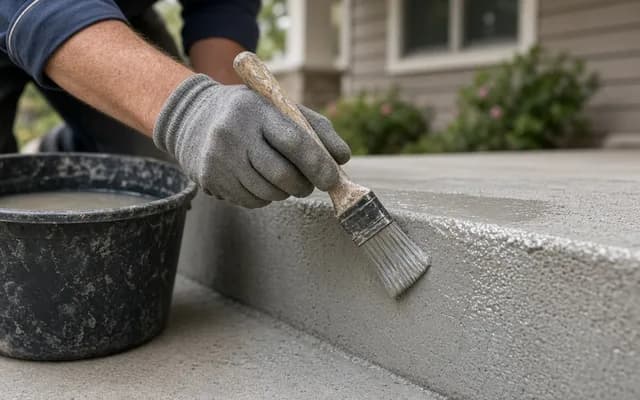
Sealing and protection treatments defend a concrete floor against stains, moisture and wear, and they range from penetrating silicates and siloxanes that leave the look unchanged to film-forming acrylics, urethanes and epoxies that add gloss and a wear layer.
Tell us the size, the condition of what is there now, and what you want to change. Concrete Finish Notes passes your request to independent local professionals, who reply with written, no-obligation estimates. The service is free to use.