What worries you most about the project?
No votes yet. Yours will be the first. · saved on this device
Loading...
Concrete Finish Notes · Reviews
This site does not rate or rank contractors. This page explains how to read third-party reviews of polishing, staining, grinding and sealing pros critically: which details show the reviewer understood what they bought, which complaints point to a process failure versus an expectation gap, and what to ask a reference. Reviews are one input; a mock-up and a written specification are stronger.
Concrete finishing reviews are unusually hard to read, because the most common complaint, 'the floor does not look like the photos,' is often not the contractor's fault and sometimes entirely is. A reviewer who expected a showroom Level 4 on a patched 1960s basement slab was going to be disappointed by anyone; a reviewer who was promised a mock-up and never got one was let down by the pro. Telling the two apart is the skill.
The same applies to praise. 'Beautiful floor, great crew' tells you nothing about whether the edges were ground close, the readings were taken or the guard was applied. The Concrete Polishing Council calls for 3 tests per 1,000 sq ft to verify gloss and clarity, and a reviewer who mentions readings or the maintenance instructions they were given has told you more than ten five-word raves.
Look for the vocabulary. A reviewer who names the level or sheen, mentions the exposure or 'salt-and-pepper,' describes the mock-up, or says what was done about a crack has understood what was bought. A reviewer who says the pro explained that a patch would show, and it did, and they were fine with it, has described a good process. Photos taken at edges and near patches, not just from the center of the room, are worth more than any adjectives.
Look for time. A review written the week the floor was finished tells you about the crew's manners; one written a year later tells you about the guard, the slip resistance, the crack filler and whether dulling happened. HomeAdvisor's note that polished floors last 20 years or more is only tested by reviews with some age on them. Stakes are real, too: HomeAdvisor says most homeowners spend around on polished concrete, so a review describing how a pro handled a return visit is worth finding. Sort by date and read the old ones first.
Homeowner polls
No votes yet. Yours will be the first. · saved on this device
The CPC exposure chart recommends a mock-up on the actual slab.
No votes yet. Yours will be the first. · saved on this device
 Service guideConcrete Polishing
Concrete polishing grinds an existing slab with progressively finer diamond abrasives, hardens it with a densifier and refines it to a specified sheen and aggregate exposure.
 Service guideConcrete Staining & Dyeing
Staining and dyeing add color to a concrete slab by penetrating the surface rather than covering it, so the aggregate, patches and variation remain part of the look.
 Service guideConcrete Grinding & Leveling
Grinding uses coarse diamond tooling to remove coatings, adhesives, lips and high spots and to open a surface profile for whatever finish follows.
Tell us the size, the condition of what is there now, and what you want to change. Concrete Finish Notes passes your request to independent local professionals, who reply with written, no-obligation estimates. The service is free to use.
Contractor problems: swirl marks, a visible band where passes overlapped, edges that read dull or lighter, dust through the house, slurry left in the yard, a guard that streaked, a dye that lifted under the sealer, no readings taken, no mock-up offered, a price that changed without a scope change. These are process failures and they repeat; if two reviews mention edges, the pro's edge method is the problem.
Slab problems: patches that show, tack-strip holes, a crack that reopened, darker areas where oil had soaked in, aggregate that differs between pours. These appear on every polished renovation slab, and renovation is 42.72% of the market per Mordor Intelligence. The question is whether the reviewer was told in advance. Budget matters as well: HomeGuide's gloss ladder runs $3–$6 up to $6–$15 per square foot from matte to high gloss, and a dull floor after a cut in passes is a lower level, not poor work. 'They warned me the crack would show and it does' is a good review; 'they never mentioned the patches' is a process failure dressed as a slab problem.
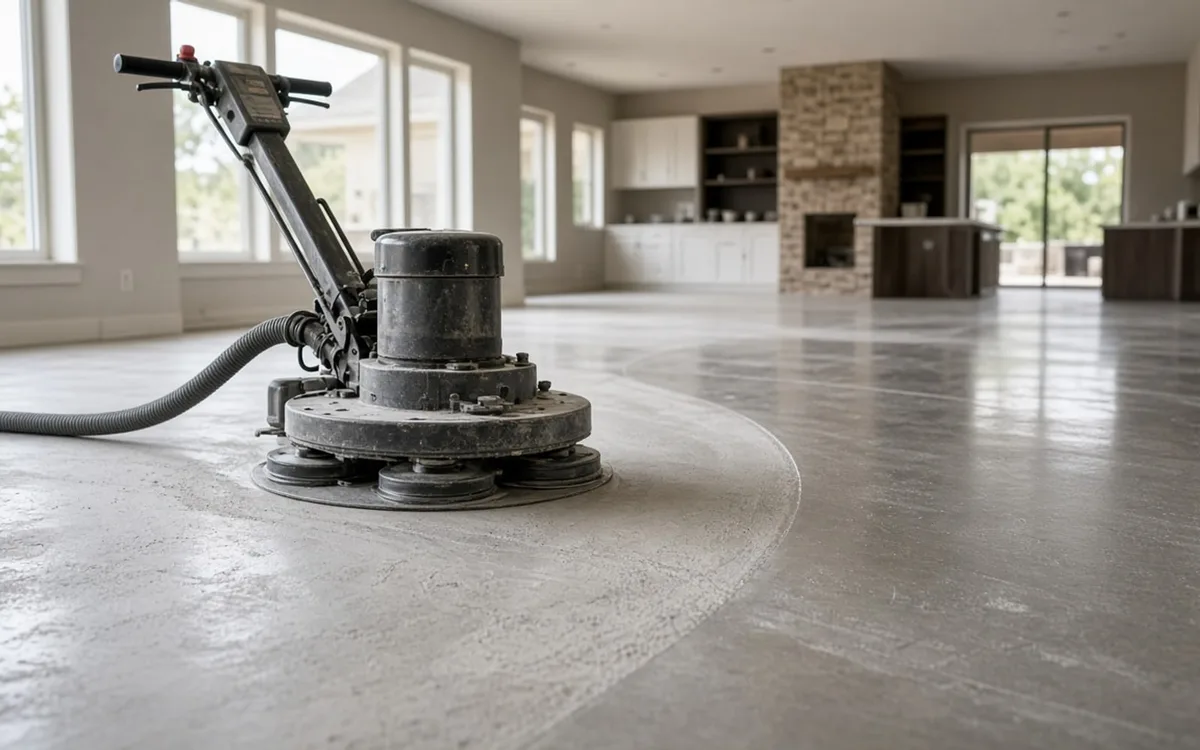
Below a written specification and a mock-up. A pro with mixed reviews who offers a 10-by-10 sample at your level and class, takes gloss and DOI readings per the CPC chart's 3 tests per 1,000 sq ft, and lists removal, edges and repairs separately is offering more protection than a pro with perfect reviews and a one-line quote. Reviews screen out the pros not to call; the proposal decides whom to hire.
Use platform reviews for pattern, not for score. A dozen reviews mentioning honest expectation-setting beat a higher average built on brief praise. Check that the reviewer's job resembles yours; a two-car garage, which 27.8% of homes have by our analysis of the federal 2024 household survey, is a different job from a basement: a reviewer praising a 15,000-square-foot warehouse polish tells you little about a 700-square-foot basement, where HomeGuide's $8–$15+ vs $3–$6 premium and hand-ground edges are the whole story. Then read the service page for what a good proposal contains.
Whether a mock-up was done and whether the floor matched it. How the edges look next to the field. Whether readings were taken at closeout and shared. What the pro said in advance about patches and cracks, and whether that matched the result. Whether the price changed once the covering came up and, if so, whether the reason was explained. How the floor has held up, whether the guard has been reapplied, and whether anything has dulled or stained.
Ask to see the floor if you can, and look at the edges, the doorways and the spot where furniture sits. A reference who volunteers a flaw and how it was handled is the most useful reference there is. Then run the calculator for your own floor, write the request with the items on the contact page, and compare what comes back against what the references described.
Because it cannot verify them and does not want to imply endorsement. Ratings on a matching site create pressure to rank the pros who respond most, not the pros who do the best work. Third-party platforms with verification, and direct references, are better sources. This page teaches how to read those, and the service pages teach what a strong proposal looks like.
Fewer than you would think, if they are detailed. Five reviews that describe the mock-up, the edges and how cracks were handled tell you more than fifty that say 'great job.' Look for pattern across reviews: repeated mentions of the same strength or the same flaw. A newer pro with two detailed, dated reviews and a strong proposal may be a better bet than a busy one with vague praise.
Trust them for what they show and not for what they hide. Center-of-room photos in good light flatter any polish. Ask for, or look for, photos of edges at walls, doorways, patches and joints. A reviewer who posts a close-up of a filled crack and says they are happy with it has given you the most useful image on the page.
A lot. Dust through the house means extraction was inadequate or containment was skipped, and silica dust is a health issue, not just a cleanup one. One dust complaint may be a bad day; two is a method. Ask any pro how they comply with OSHA's silica rule, what filtration their extractors use, and how they seal the work area, and compare the answer to what reviewers reported.
It can be. A high-gloss polish with a smooth guard at an entry can fall below ANSI A326.3's 0.42 wet DCOF minimum, and a pro who did not raise slip resistance for a wet area has missed something. But the owner may also have chosen Level 4 against advice. Ask the reference whether slip was discussed and whether a slip-resistant guard was offered.
Ask for certificates of liability and workers' compensation insurance and verify the state license if your state requires one for flooring or concrete work. Ask about CPC membership through ASCC, which counts ~750 companies as members working to the appearance and exposure charts. Ask for two finished residential floors to see in person. Then compare proposals on specification, not just price.
Newer or mostly commercial pros often have none online. Ask for references from recent jobs, ideally residential ones, and for photos of edges and details. A pro who offers a mock-up, works to the CPC charts and writes a line-item proposal is showing you the process directly. Weigh that against the absence of reviews rather than treating the absence as disqualifying.
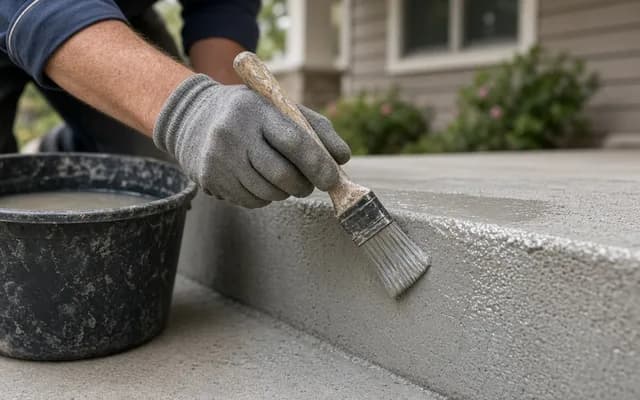
Sealing and protection treatments defend a concrete floor against stains, moisture and wear, and they range from penetrating silicates and siloxanes that leave the look unchanged to film-forming acrylics, urethanes and epoxies that add gloss and a wear layer.