Northeast
Basements over half of homes and slabs in only 16%; expect thin, older basement slabs, stair access premiums, cool drying conditions and salt tracked into garages. Penetrating sealers outdoors; joints treated in garages.
Loading...
Concrete Finish Notes · Locations
Polishing is indoor work, but the slab underneath is regional. Slab-on-grade living areas dominate the South and West, basements the Midwest and Northeast, and each brings its own access, moisture and soil issues. This page summarizes the housing data by region and the planning notes that follow from it, so a request to local professionals starts from the right assumptions.
Our analysis of the federal government's 2024 household survey shows how different the four regions are. Homes over a concrete slab are 32.4% of housing nationally but 43% in the South and 39% in the West, against 20% in the Midwest and 16% in the Northeast. Basements are the mirror image: 58% of Midwest homes and 52% of Northeast homes sit over one, versus 13% in the South and 14% in the West.
Those numbers decide what a typical residential polishing job looks like. In Texas or Arizona it is a living area on a slab with tile or carpet to remove. In Ohio or Massachusetts it is a basement with stairs, a furnace and a slab of unknown age. The costs, the access premiums and the moisture questions follow from that, and the service pages apply everywhere once you know which floor you have.
Basements over half of homes and slabs in only 16%; expect thin, older basement slabs, stair access premiums, cool drying conditions and salt tracked into garages. Penetrating sealers outdoors; joints treated in garages.
Slab-on-grade in 43% of homes and the bulk of new slab completions; tile and carpet removal is the first line, vapor retarders may be absent on older slabs, and expansive clay makes lips and settled corners recurring rather than fixable by grinding alone.
Basements in 58% of homes and 41% of those unfinished nationally; basement polishing and grind-and-seal are the common jobs, frost heave affects garages and porches, and equipment access should be planned before framing.
Slab-on-grade in 39% of homes with post-tensioned slabs common in expansive-soil areas; confirm slab type before deep exposure, specify UV-stable dyes and guards in sunlit rooms, and expect polishing labor toward the top of the range in coastal metros.
The South and West. Census data shows 754,000 new single-family homes completed on slab or other non-basement foundations in 2025, most of them in those two regions, up from 641,000 in 2021. A slab-on-grade living area is the easiest residential polishing job: ground-level access for equipment, large open areas that keep the per-square-foot cost toward the low end of HomeGuide's $3–$12 per sq ft, and newer concrete with more consistent aggregate. Garages add to the count: the same survey found 53.0% of owner-occupied homes with an attached garage also report a slab foundation.
The complications are coverings and moisture. Most of these slabs are under tile, carpet or vinyl, and removal with adhesive is the first line on the proposal. Older slabs in humid states often lack a vapor retarder, which does not stop a polish but does affect dye and any film sealer. Post-tensioned slabs, common in expansive-soil areas, must not be cut or cored casually; tell the pro if the house has one, and read the grinding page on tolerances before agreeing to deep exposure.
Access, age and moisture. HomeGuide's +10% to 30% for hard-to-reach basements applies to most of them: grinders come down stairs in pieces or on ramps, and the field is broken up by posts, the furnace, the water heater and stair stringers, all of which mean hand-ground edges. Slabs in pre-1970 basements can be thin and unreinforced, which limits how deep a pro can cut for aggregate exposure.
Our analysis found 41.1% of basement homes nationally still have an unfinished basement, and 52.4% in the Northeast against 26.5% in the West. Finished basements, 58.9% nationally, run from 47.6% in the Northeast to 73.5% in the West. The market for turning a bare basement slab into a finished floor is largest where finished basements are rarest. Polishing or a grind-and-seal suits basements well because there is nothing to trap moisture and nothing to peel. Moisture testing before any dye or guard is standard, and a sump and dehumidifier make drying times predictable. Involve the polishing pro before framing so edges and access are planned.
Expansive clay across Texas, the southern plains and parts of the Mountain West heaves and shrinks with soil moisture, producing joints that lift and corners that settle. Grinding a lip on one of those slabs is temporary unless the moisture cycle is controlled; the leveling page explains which conditions need jacking and which need an engineer. Frost in the northern tier lifts unheated garage and porch slabs each winter, and a garage floor polished in a freeze-thaw state needs joints treated so salt water does not sit in them. Attached garages are 42.9% of homes nationally by our analysis, from 31.2% in the Northeast to 49.9% in the West, and three-car garages are 6.0% nationally but 9.4% of Western homes.
Sandy coastal soils and high water tables in Florida and the Gulf bring moisture up through slabs, which argues for penetrating protection and against film sealers indoors. The sealing page covers breathable products for exterior slabs in freeze-thaw regions, where a film sealer on a patio is the most common cause of spalling a pro sees.
Labor does. HomeGuide's $40–$100 per hour range spans urban and rural markets, and a polishing crew in a coastal metro sits near the top. Equipment, diamonds and densifier cost about the same everywhere. What moves the total more than region is the job type region produces: an 1,800-square-foot slab-on-grade living area in the South is cheaper per square foot than a 700-square-foot Northeast basement with stairs, not because of local wages but because of size and access.
Contractor density also varies. The U.S. polished concrete market of $679 million is concentrated where commercial construction is, and metros with big-box retail and distribution centers have the deepest bench of CPC-trained pros, some of whom take residential work between commercial jobs. Smaller markets may have one or two, and their schedules set your timeline. Ask early and use the estimate request to reach everyone who serves your area.
| Region | Homes over a slab (EIA 2024) | Homes over a basement (EIA 2024) | Typical residential job |
|---|---|---|---|
| Northeast | 16% | 52% | Older basement slab; access and thickness checks |
| Midwest | 20% | 58% | Basement finishing; frost-affected garages |
| South | 43% | 13% | Slab-on-grade living areas; tile and carpet removal |
| West | 39% | 14% | Slab-on-grade; post-tensioned slabs; UV on dyes |
Homes built on a concrete slab: 32.4% nationally. Highest in Arizona (63.8%), New Mexico (58.6%), Florida (57.7%); lowest in Rhode Island (9.1%), Vermont (11%), Massachusetts (11.1%).
Homes built over a basement: 42.9% nationally. Highest in Connecticut (91.7%), Massachusetts (91.2%), Nebraska (91.1%); lowest in Arizona (3%), Arkansas (7.2%), California (7.9%).
Homes with an attached garage: 42.9% nationally. Highest in Idaho (60.4%), Utah (59.9%), Nevada (57.7%); lowest in District of Columbia (5.1%), New York (23.2%), Massachusetts (25.9%).
Concrete Finish Notes calculated these state estimates from the Energy Information Administration's 2024 household survey microdata. EIA publishes the 2024 survey nationally and by region, not by state. Shares are weighted; a dash means the state sample was too small for a reliable estimate (fewer than 100 households, fewer than 10 yes answers, or a relative standard error above 30%). Source data.
| State | Homes built on a concrete slab | Homes built over a basement | Homes with an attached garage |
|---|---|---|---|
| United States | 32.4% | 42.9% | 42.9% |
| Alabama | 34.8% | 16.3% | 37.4% |
| Alaska | 26.8% | 24.8% | 43.7% |
| Arizona | 63.8% | 3% | 53.1% |
| Arkansas | 40.7% | 7.2% | 42.4% |
| California | 42% | 7.9% | 48.5% |
| Colorado | 24.3% | 66.6% | 53.5% |
| Connecticut | 15.8% | 91.7% | 40.5% |
| Delaware | 24.8% | 56.9% | 52.3% |
| District of Columbia | 11.4% | 83.2% | 5.1% |
| Florida | 57.7% | — | 52.3% |
| Georgia | 37.6% | 25.8% | 47% |
| Hawaii | 45.1% | — | 42.3% |
| Idaho | 18.1% | 30.9% | 60.4% |
| Illinois | 17.7% | 77.5% | 41.2% |
| Indiana | 27.2% | 49.8% | 44.6% |
| Iowa | 19.8% | 88% | 50.7% |
| Kansas | 18.8% | 72.3% | 51.6% |
| Kentucky | 19.2% | 49.8% | 40.3% |
| Louisiana | 55.2% | — | 33% |
| Maine | 13.3% | 82% | 30.5% |
| Maryland | 25.8% | 76.5% | 34.6% |
| Massachusetts | 11.1% | 91.2% | 25.9% |
| Michigan | 17.5% | 86% | 42.9% |
| Minnesota | 24.1% | 85.8% | 44% |
| Mississippi | 57% | — | 35% |
| Missouri | 22.7% | 75.2% | 48.6% |
| Montana | 20.2% | 60.9% | 40.5% |
| Nebraska | 19.2% | 91.1% | 51.4% |
| Nevada | 47.4% | — | 57.7% |
| New Hampshire | 12.9% | 91.1% | 37% |
| New Jersey | 22.5% | 71.3% | 36.1% |
| New Mexico | 58.6% | — | 46.9% |
| New York | 13% | 85.1% | 23.2% |
| North Carolina | 28.1% | 20.6% | 37.9% |
| North Dakota | 19.9% | 88.3% | 45.8% |
| Ohio | 20% | 76.6% | 42.3% |
| Oklahoma | 54.3% | 8.4% | 50.7% |
| Oregon | 22.8% | 21.9% | 50.5% |
| Pennsylvania | 19% | 89.8% | 39.7% |
| Rhode Island | 9.1% | 90.5% | 27.2% |
| South Carolina | 36% | — | 48.2% |
| South Dakota | 20.7% | 85.9% | 53.2% |
| Tennessee | 30.5% | 29.7% | 38.4% |
| Texas | 56% | — | 47.2% |
| Utah | 28.8% | 74.9% | 59.9% |
| Vermont | 11% | 88.6% | 28% |
| Virginia | 26% | 48.8% | 33.1% |
| Washington | 26.1% | 34.3% | 44.9% |
| West Virginia | 20.7% | 64% | 34.3% |
| Wisconsin | 16.3% | 90.1% | 41% |
| Wyoming | 18% | 65.1% | 43.7% |
Homeowner polls
No votes yet. Yours will be the first. · saved on this device
Older slabs often have thinner sections, unknown mixes and more patches, all of which show after grinding.
No votes yet. Yours will be the first. · saved on this device
It changes what must be avoided. Post-tensioned slabs, common in Texas, Arizona, California and Florida, contain stressed steel tendons that must never be cut or drilled. Polishing, staining and sealing are surface work and are fine; deep saw-cut decorative scoring, anchor drilling and any leveling that involves coring are not without locating the tendons first. Tell every pro if the house has one.
Size and access. HomeGuide's premium of 10% to 30% for hard-to-reach basements reflects moving heavy grinders down stairs and hand-grinding around posts, the furnace and stair stringers. Basements are also usually smaller than main-floor living areas, which pushes them toward the small-job end of HomeGuide's range. The room, not the region, is the driver.
Yes. A polished garage in the Midwest or Northeast needs a stain guard for road salt and de-icer, joints filled so brine does not sit in them, and a floor drain or squeegee routine. Frost heave at the apron or a slab with movement should be addressed first. Many owners in those states choose a Level 2 finish with a slip-resistant guard for wet winter entry.
Not for the polish itself, which has no film to blush. Humidity slows densifier and guard drying and can bring efflorescence to the surface of a slab without a vapor retarder, which the pro removes before final passes. Dyes and any film sealer are more sensitive, and a moisture test before color is standard practice in Florida and along the Gulf.
Yes. The trade follows commercial construction, so metros with warehouses, big-box retail and schools built in the last twenty years have more CPC-trained pros. Rural areas and small markets may have one or two, and they may travel, adding mobilization cost. Requesting estimates early and describing the job precisely improves the odds of a good match anywhere.
Locally, yes. After a regional disaster, concrete and flooring contractors are booked for months and prices rise. New slabs placed for rebuilt homes can be specified for polishing from the start, which produces a more uniform floor than renovating an old slab. If you are rebuilding, tell the builder early so the slab mix, finishing and curing suit a polish.
Only at the margins. Dry mountain air speeds sealer and guard drying and can cause lap lines if the applicator works too slowly, and UV is stronger, which matters for dyes. Cold garages at altitude have longer freeze-thaw seasons. None of this changes the specification; it changes the product choice and the day the work is done.
 Service guideConcrete Polishing
Concrete polishing grinds an existing slab with progressively finer diamond abrasives, hardens it with a densifier and refines it to a specified sheen and aggregate exposure.
 Service guideConcrete Staining & Dyeing
Staining and dyeing add color to a concrete slab by penetrating the surface rather than covering it, so the aggregate, patches and variation remain part of the look.
 Service guideConcrete Grinding & Leveling
Grinding uses coarse diamond tooling to remove coatings, adhesives, lips and high spots and to open a surface profile for whatever finish follows.
 Service guideConcrete Sealing & Protection
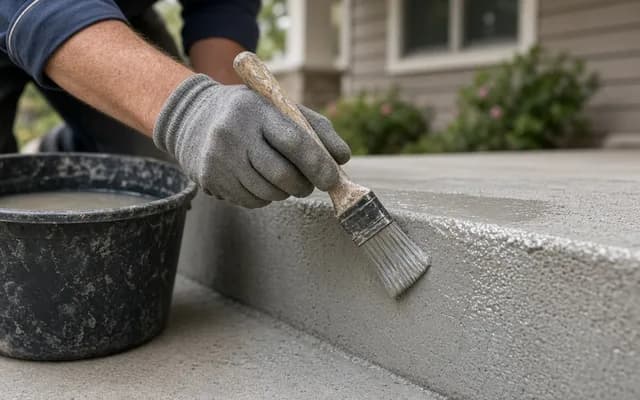
Sealing and protection treatments defend a concrete floor against stains, moisture and wear, and they range from penetrating silicates and siloxanes that leave the look unchanged to film-forming acrylics, urethanes and epoxies that add gloss and a wear layer.
Tell us the size, the condition of what is there now, and what you want to change. Concrete Finish Notes passes your request to independent local professionals, who reply with written, no-obligation estimates. The service is free to use.