Which space is the project?
No votes yet. Yours will be the first. · saved on this device
Loading...
Concrete Finish Notes · Services
Four services cover most concrete floor projects: polishing that grinds and densifies the slab to a chosen sheen, staining and dyeing that add color while keeping the concrete visible, grinding and leveling that prepare or correct a surface, and sealing that protects a finish against stains and wear. Choose by what the slab needs and how the room is used, then compare proposals.
The four services share equipment and often a contractor, but they answer different questions. Polishing answers 'what can this slab look like.' Grinding answers 'what does this slab need before anything else.' Staining answers 'what color, on top of what the slab already is.' Sealing answers 'how do I protect what I have.' Most projects combine two or three; a polished, dyed floor with a stain guard is one job with three of them.
Costs overlap accordingly. Angi's 2026 range of $3–$12 per sq ft covers polishing; HomeGuide prices staining at $3–$15 per sq ft, leveling at $3–$12 per sq ft and cleaning-and-sealing at $1–$3 per sq ft. This page helps you pick which service page to read first and which to ask for when you request estimates.
 Service guideConcrete Polishing
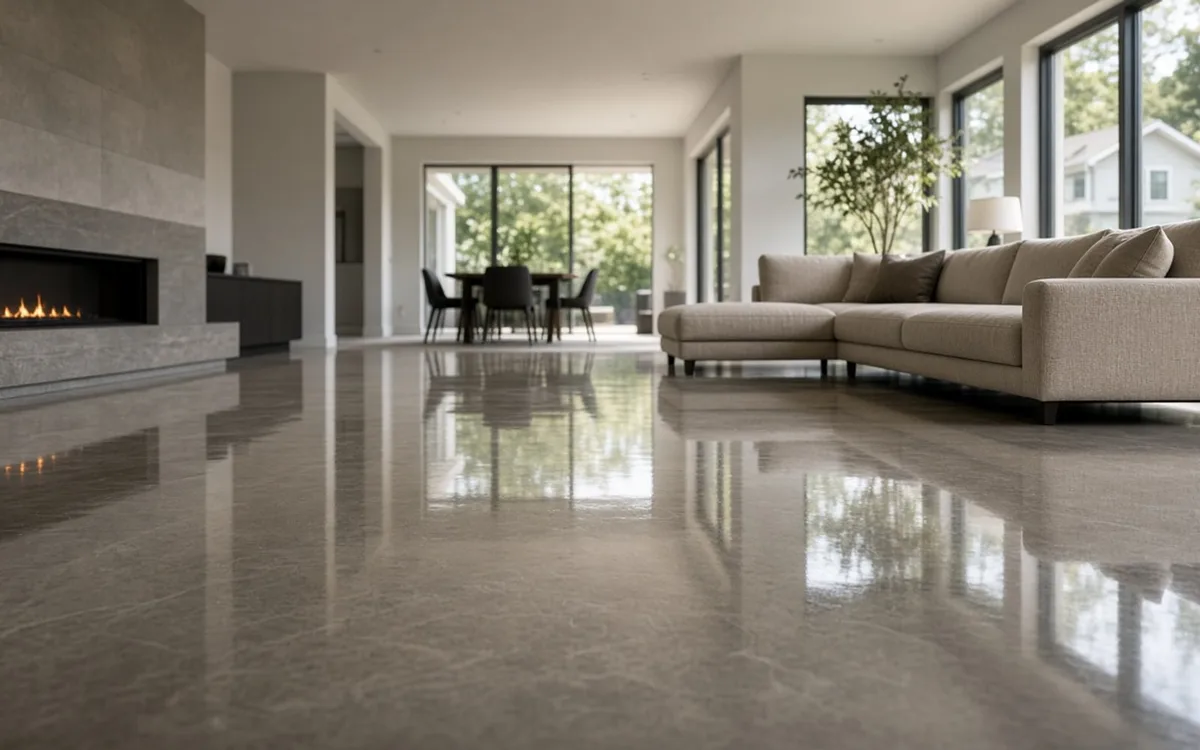
Concrete polishing grinds an existing slab with progressively finer diamond abrasives, hardens it with a densifier and refines it to a specified sheen and aggregate exposure.
 Service guideConcrete Staining & Dyeing
Staining and dyeing add color to a concrete slab by penetrating the surface rather than covering it, so the aggregate, patches and variation remain part of the look.
 Service guideConcrete Grinding & Leveling
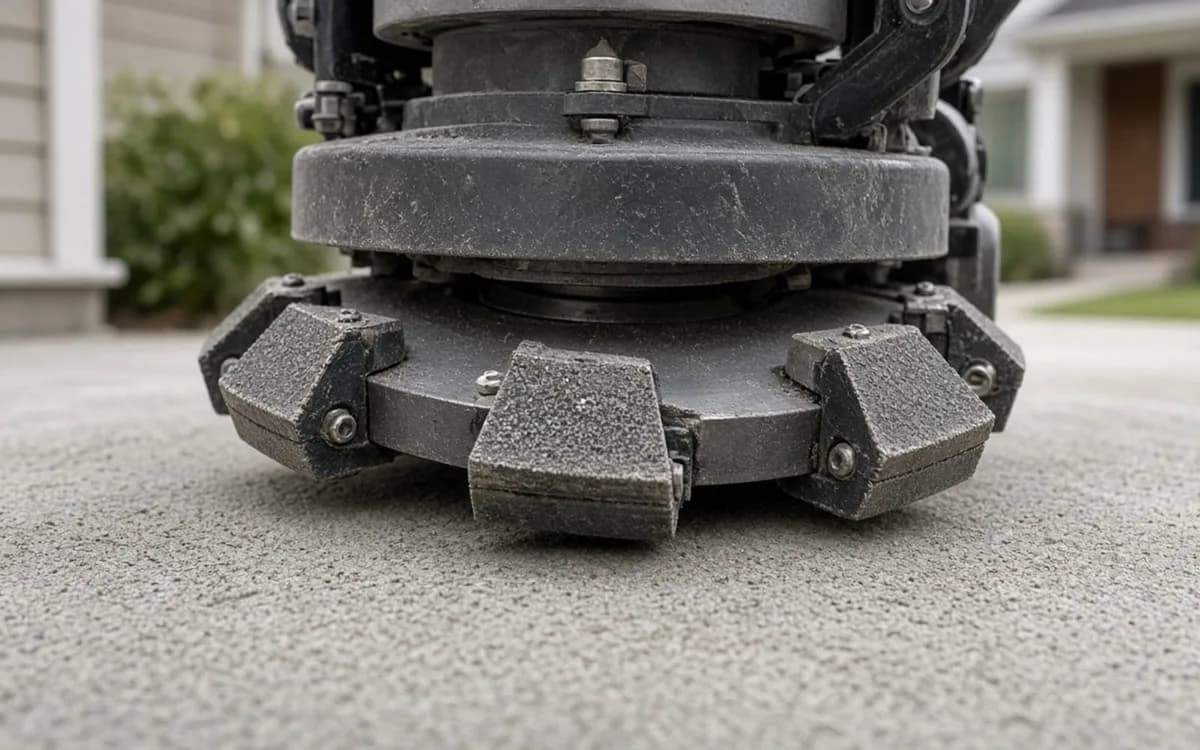
Grinding uses coarse diamond tooling to remove coatings, adhesives, lips and high spots and to open a surface profile for whatever finish follows.
 Service guideConcrete Sealing & Protection
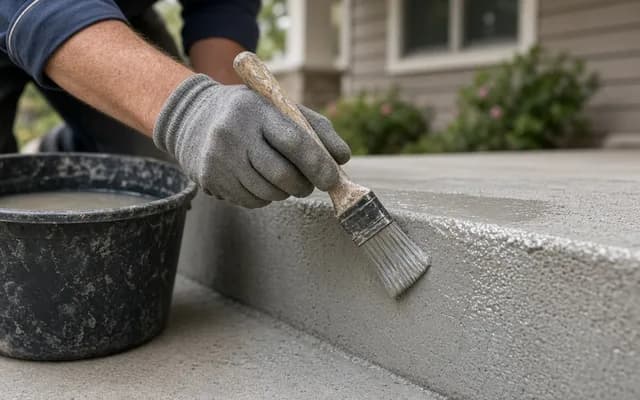
Sealing and protection treatments defend a concrete floor against stains, moisture and wear, and they range from penetrating silicates and siloxanes that leave the look unchanged to film-forming acrylics, urethanes and epoxies that add gloss and a wear layer.
| Service | Best for | Skip it if |
|---|---|---|
| Concrete Polishing | Sound slabs in living areas, basements, garages, shops and retail where a hard, low-maintenance, reflective floor is wanted and the owner accepts the slab's character. | The slab is soft or heavily patched, you need a perfectly uniform color, or the area is too small to absorb equipment mobilization. |
| Concrete Staining & Dyeing | Owners who want color and variation on an exposed slab, whether polished afterward or sealed, and who will approve a sample on their own floor. | The slab has an old sealer or coating that cannot be fully removed, or you expect the color to be even across patches and repairs. |
| Concrete Grinding & Leveling | Removing coatings and adhesives, flattening high spots and lips, opening a profile for a coating or overlay, or correcting low spots with overlays or jacking. | The problem is structural movement, heaving or active settlement, which grinding cannot fix and leveling may only mask. |
| Concrete Sealing & Protection | Bare or stained slabs that need stain and moisture resistance, exterior concrete, and polished floors in kitchens or garages that want a stain guard. | You want to polish later, since some sealers must be ground off first, or the slab has active moisture that a film sealer would trap. |
By the numbers
$3–$12 per sq ft
Angi prices polishing an existing concrete floor at $3 to $12 per square foot
Angi's polishing cost guide describes polishing existing floors; removal of coverings, repairs, design effects and new slab construction are separate scope items. It is the benchmark behind this site's calculator.
Angi cost to polish concrete floors (2026)$3–$15 per sq ft
Staining an existing concrete floor costs $3 to $15 per sq ft; acid stain up to $25
HomeGuide's February 2026 guide: basic single-color stain and seal is $3–$5, two colors $5–$10, multi-color patterns $10–$15, and stenciled or scored high-end designs $15–$25 per sq ft.
HomeGuide cost to stain concrete floors (2026)$3–$12 per sq ft
Concrete leveling costs $3 to $12 per sq ft, or $700 to $5,000 per project
HomeGuide's November 2025 guide: self-leveling overlays for interior floors run $2–$5 per sq ft, mudjacking $4–$9, and polyurethane foam jacking $8–$25, with $300–$700 minimum job fees.
HomeGuide concrete leveling cost guide (2025)$1–$3 per sq ft
Concrete cleaning and sealing costs $1 to $3 per sq ft; epoxy or polyaspartic sealers up to 3x more
HomeGuide's November 2025 guide lists sealer at $30–$80 per gallon, labor at $0.70–$1.25 per sq ft, and $150–$300 minimum service fees.
HomeGuide concrete sealing cost guide (2025)Polishing removes the top of the slab with diamond abrasives in successive passes, applies a densifier that reacts with the concrete to harden it, and refines the surface to a specified CPC level. It is subtractive and permanent. Grinding and leveling uses the coarse end of the same process to remove coatings, flatten high spots or open a profile for a following finish; leveling with overlays or jacking corrects low spots and settled slabs. The candidate floors are common: our analysis of the federal government's 2024 household survey found 32.4% of occupied homes sit over a concrete slab and 29.5% over a basement.
Staining and dyeing adds color that penetrates rather than sits on top. Acid stains react with the concrete's minerals for mottled earth tones; dyes and water-based stains deliver a broader palette. Both depend on absorption, so they belong after grinding and before final polishing or sealing. Sealing and protection applies a penetrating or film-forming product to resist stains, moisture and wear, or a stain guard on a polished floor where spills happen.
Polishing's cost is passes: HomeAdvisor's $3–$5 per sq ft per additional grinding pass explains why Angi's July 2026 guide prices high gloss at $8–$15/square foot against $2–$6/square foot for matte. Grinding and leveling's cost is method: self-leveling overlays at $2 to $5 per square foot, mudjacking at $4 to $9, foam jacking at $8 to $25 per HomeGuide. Staining's cost is complexity: single color at $3 to $5, multi-color patterns at $10 to $15, stenciled or scored designs to $25. Sealing's cost is product: HomeGuide's $1 to $3 for cleaning and sealing, up to three times more for epoxy or polyaspartic.
Use the calculator for a planning range on polishing, then add the service-specific lines from each page. If the slab is not poured yet, Angi puts a new slab at $4–$8/square foot before any finish. Sequencing matters too: HomeGuide prices color add-ons on a polished floor at $1–$3 dye; $3–$5 stain per square foot, and one contractor grinding, staining and sealing in sequence avoids paying mobilization twice. The comparison pages help when two services compete for the same floor, such as polishing versus epoxy in a garage or staining versus dyeing in a living room.
| Service | Typical range | Main driver | Source |
|---|---|---|---|
| Polishing | $3–$12 per sq ft | Gloss level and aggregate exposure | Angi 2026; HomeGuide 2026 |
| Staining and dyeing | $3–$15 per sq ft; $1–$3 dye add-on | Number of colors and pattern complexity | HomeGuide 2026 |
| Grinding and leveling | $3–$12 per sq ft | Method: overlay, mudjacking, foam | HomeGuide 2025 |
| Sealing and protection | $1–$3 per sq ft | Product type and prep | HomeGuide 2025 |
Skip polishing when the slab is soft, heavily patched or oil-saturated, or when you need a uniform color that concrete cannot give; consider an overlay or a coating instead. Skip staining when the slab has been sealed or coated and cannot be fully stripped, since color will not penetrate evenly. Skip grinding as a cure for settlement, heaving or structural cracks; those need leveling by other methods or structural repair. Skip sealing a polished floor with a film-forming product; it defeats the point of the densified surface.
A pro who tells you the slab is a poor candidate has given you useful information. Ask what would change that: a hardener, an overlay, a repair, a different finish. The finish quiz flags most of these situations, and the reviews guide explains how to tell from other homeowners' experience whether a contractor gives that kind of honest answer.
Homeowner polls
No votes yet. Yours will be the first. · saved on this device
No votes yet. Yours will be the first. · saved on this device
Often, because polishing contractors own the grinders and the densifiers and usually offer dyes and guards. Leveling by mudjacking or foam is frequently a separate specialist, and decorative acid staining with patterns is its own craft. Ask each pro which services they perform with their own equipment and which they subcontract, and to show a finished example of the specific service you want.
Grinding first, to remove coverings and open the surface. Repairs next. Then dye or stain if color is wanted, applied at the grit stage the product specifies. Then the finer polishing passes and densifier. Finally a guard or sealer if the room calls for one. A proposal that combines services should state the sequence, because color applied at the wrong stage will grind away or fail to penetrate.
Yes, if the slab is sound and not oil-saturated. A polished garage at CPC Level 2 or 3 with a stain guard resists tire marks and cleans easily, and HomeGuide notes a guard is worth it there. Oil that has soaked into the concrete will show as darker areas after polishing and cannot be ground out, which is why a sample in the worst spot is wise.
Only if the stain was applied within a polishing sequence and no film sealer was used. A stained-and-sealed floor has to be ground to remove the sealer, which also removes most of the color. If you might polish later, tell the pro now so the stain is applied at the right stage and the protection is a penetrating guard rather than a film.
Grinding is the coarse start of the process, typically 30 to 80 grit metal-bond diamonds, that removes material and coatings. Polishing continues through finer resin-bond grits, often to 800, 1,500 or 3,000, with densifier applied partway through. A ground floor is flat and dull; a polished floor is refined and reflective. Grinding alone is a preparation service; polishing is a finish.
They will treat cracks, not erase them. Cracks are cleaned, filled with a semi-rigid polyurea or epoxy and ground flush, and they remain visible as filled lines. Moving cracks will reopen. Leveling addresses slabs that have settled unevenly, but a crack that is still moving needs its cause addressed. Ask how each crack in your slab will look after the work.
Usually grinding to remove old coverings followed by a penetrating sealer, at HomeGuide's $1 to $3 per square foot for cleaning and sealing plus the removal cost. It produces a clean, dust-free, moisture-tolerant floor without the passes a polish requires. A matte polish at $3 to $6 is the next step up if the slab is sound and you want a finished look.
 Free toolPolished concrete cost calculator: a planning range for your square footage
Size, material tier and complexity in, a realistic budget range out.
 Free toolConcrete floor options compared on the numbers
Side-by-side tables for the decisions that change the price most.
 Free toolConcrete finish quiz: can you read a polishing proposal?
9 questions that show what you already know and what to check next.
 Free toolPolls: what other homeowners planning concrete floors decided
See what other planners chose and add your vote.
Tell us the size, the condition of what is there now, and what you want to change. Concrete Finish Notes passes your request to independent local professionals, who reply with written, no-obligation estimates. The service is free to use.